Monday, October 13, 2014

Art in the Afternoon…..Bucharest, The Cotroceni National Museum

The Cotroceni National Museum Palace

Every year I try to make the most of my trips to Romania and the unique blend of traditions, art and culture, food and places to enjoy it, people to meet.
Monastery Cotroceni Iconostasis 

This October it was no different…a tapestry of rural delights, vineyards, forests and historic towns woven in a rich autumn palette.
                     
      
Poiana Brasov Autumn
The choice for one afternoon was art…art in Bucharest. I had few hours set aside to dive deep in the one place I had not visited in a couple of years…The Cotroceni National Museum.

Palace Interior
Three centuries of history embrace the structures and land vibrations of the museum, all interwoven with politics, historical facts, religious and cultural aspects.

It started with the founder, Prince Serban Cantacuzino who ruled between 1678-1688 and continued through the times with the imprint of various dignitaries and a long list of personalities.
Prince Serban Cantacuzino
My interest….interiors, architecture and decorative arts, ready for a visual feast.

Palace Salon


Queen Marie's Bedroom

Cotroceni Norwegian Salon

Cotroceni German Dining Room

      
King Ferdinand's Library

Cotroceni Salon Oriental


Bronze Vessel

Art Nouveau Brass Covered Vessel

Since this is also the official headquarter and residence of the President of Romania, I shall stroll through the gorgeous grounds….on my way out hoping to say Buna Ziua!


Friday, August 15, 2014

Dormition of The Mother of God…..Traditions in Romania


Dormition Of The MOG Fresco 
Should you pass by Curtea de Arges Monastery, situated on the right bank of the Argeş River flowing through the valley of the lower Carpathians (the Făgăraş Mountains) on August 15th, you would be greeted by pilgrims celebrating Dormition of The Mother of God, Virgin Mary.
Curtea de Arges Monastery


Monastery Mosaic
Every year, the day of the Dormition, Monastery Curtea de Arges, dwelling built in the early sixteenth century by ruler Neagoe Basarab, awaits believers who come to worship the Virgin Mary and Saint Philothea.

Curtea de Arges Cupolas

Monastery Interior

Ancient folk traditions are transcending in various parts of Romania, each specific to the microcosm of the region.

By the Danube and the Black Sea, sailors celebrate as St. Mary is their protector, Romania Navy Day.

The autumn season starts with celebrations in the vineyards, planting of the wheat fields as well as feasts and pilgrimages at the monasteries with the name of the Virgin or the Dormition.
Văratec Monastery

The feast day at Văratec Monastery, the nuns are preparing for the believers who will cross the threshold of the monastery.

Humor Monastery

While traveling through Moldova, one has to discover the culinary delights of the region as well.
Stuffed Cabbage and Polenta
Mucenici Moldova Pastry

Bors Moldovenesc

Meatball Sour Soup
Also on August 15th honoring their patron are Bistriţa Monastery and Hermitage Draga from Neamţ County, monasteries Zosin Cozancea from Botoşani area, monasteries Rarău, Humor, Feteşti Hermitage Orata and Plutoniţa in Suceava.

Neagoe Basarab was the Prince of Valahia between 1512 and 1521, the great ruler that built Curtea de Argeș Monastery.

  
He was canonized as Hesychast and Prince of Peace on September 26, 
2008.

Neagoe Basarab and Milica Despina


My Travel Artist


Monday, July 21, 2014

Take a Walk on the Wild Side….Sighisoara


Sighisoara, Romania

                        Sighisoara Medievala 25th-27th July 2014


Medieval Festival 2013 Vlad Tepes

Sighisoara Medieval Festival this year celebrates 20 years of existence. For 10 days, the city is seized by music, theater, medieval fighting schools, all under the patronage of Her Royal Highness, Margaret, Princess of Romania.

Medieval Festival Sighisoara

The festival runs from July 20 to 29, this year's theme is "600 Years of Struggle and Faith - Joan of Arc".

Like every year, the city becomes home to dozens of medieval knights, monks, wizards, clowns and minstrels, as well as for medieval music singers  and street jesters.
Medieval Festival Sighisoara
Medieval Festival

This year, spectators can attend schools of medieval fighting, be sentenced to death, take part inprocessions, public trials and even witch burnings.

A new feature this year is the medieval blacksmiths, where craftsmen will make a Transylvanian Excalibur, a sword that is 2.5 meters tall. This sword will remain in view in Sighisoara as the symbol of the Medieval Festival.

Citadel on the Hill


Sighisoara Citadel
In the 13th century, German craftsmen and merchants, known as Saxons, were ordered by the Hungarian sovereigns to colonize Transylvania and protect the border of the Carpathians against the steppe peoples. They settled on a hill, called the City Hill, which has revealed traces of occupation going back to the Palaeolithic period.
Sighisoara Covered Stairway

Cobblestone Street in Sighisoara

Personalized Itinerary From Travel Insider

Sunday, June 29, 2014

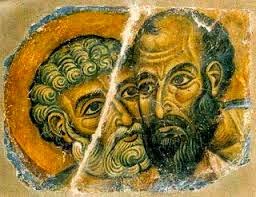
Crown of Flowers….Romanian Tradition On June 29, 2014, the Feast of Saints Peter and Paul

Saints Peter and Paul Fresco

On this Holy Sunday, centuries old folk traditions continue in villages of Transylvania, among them Crown of Flowers.

Particularly in Buneşti, old Romanian name Bundorf or Bondorf in Saxon dialect, a village in the county of Brasov, Transylvania located on the road connecting Brasov to Sighisoara.

Maramures Girls

Preparations for this day start a few days before June 29, when the village young people go into the fields to gather flowers as a celebration of nature's abundant vegetation that brings hope, renewal in the fruitfulness of the earth.
Transilvania Children'Dance
Throughout the celebration, young people dressed in the traditional folk costumes get together in traditional dances and prepare the crowns of flowers that get hung on top of pillars in the churchyard.

Flower Wreaths

Weaving of garlands is done at the home of one of the chosen village girls.
They weave two crowns: one for children, another for the youth. 

It is tradition to hide a piece of cheese and a bottle of plum brandy among the branches of the garlands for good harvest.

After the entire village is gathered around the "crown" on each pole, one young man climbs it and shouts a "zicătură". The text talks about the religious significance of the day of June 29, the feast of Saints Peter and Paul, a reminder from village priest most certainly.


Churchyard Pole Shouting

 Feasts follow at the homes of the villagers with traditional dishes and drink.
Traditional Transylvanian Pastry


The inspiration from this feast is seen in the patterns of rug weaving and at the harvest of wheat when the last few stalks and ears are made into a crown and placed on the barn wall.

Hand Woven Moldova Rug


Last Sheaf of Wheat

My Travel Artist

Saturday, May 24, 2014

Memories from Childhood….Hurezu Rooster


Hurezi Monastery Garden
As I am admiring the pottery bowls ready to serve a Romanian Eggplant Stew, memories flood my heart…enamels of ochre, spring green and rich raw umbers swirl in traditional ancient patterns, waves, snakes, spirals and my very dear rooster.
Horezu Rooster Bowl and Wooden Spoon

Symbolism in Horezu Pottery
Rooster is the bird that heralds sunrise, the beginning of a new day, maybe a new life and a new beginning.
As a symbol of light and its victory over darkness, it is said that on the night of St. Andrew, the rooster’s song called angels to come and chase the ghosts.
Horezu Plate
Spiral of life is represented on many plates the cycle of birth-death-rebirth, infinity.
Spiral of Life and Waves Pattern
 First Sunday in June, a celebration of plates and platters, bowls and pitchers erupts in Horezu village, Ramnicul Valcea area of Romania.
Potters from the area as well as neighboring counties come to show and sell their wares at village festivals.

Hurezu Pottery
Traditional pottery fired twice, the second time with the glorious enamels adorning each piece emerges from the hands of skilled potters for centuries.

Horezu Potter

Horezu Pottery

Horezu Pottery Patterns
Roaming through the region known as “Oltenia From Under The Mountain”in Romania, the traveler is greeted by "The most beautiful and exquisite specimen of Romanian architecture" Hurezi Monastery built in 1693 by Constantin Brancoveanu and included in the UNESCO treasures in 1995.

Hurezi Monastery Valcea Romania
Among other monasteries that adorn the Romanian land, Hurezi Monastery is considered, along with its surrounding buildings, the most representative architecture complex, defining "Brancovenesc Style".
Hurezi Monastery Entry

Hurezi Monastery Interior
It is located in the northern part of Valcea county, on the national road DN 67 Ramnicu Valcea - Targu Jiu, at the foothills, surrounded by woods, in a place full of charm and solitude, silence that is disturbed only at night by the song of owl-like pray birds “Huhurezi” who probably gave the name of the locality and the monastery.
Hurezi Monastery Fresco
The stew is steaming ready to be cuddled by my Rooster Hurezu bowls…Bon Appétit.. Pofta Buna!

Eggplant and Olives Stew

Ingredients:

Olive oil, Kalamata olives, eggplant, salt, pepper, bay leaf, tomato paste, basil pasta red sauce, sweet onions, red pepper, vegetable stock.

Method:

Sauté onions and red pepper finely chopped in olive oil for few minutes, add few cloves of minced garlic,  the cubed eggplant and sauté for few more minutes until tender and aromatic.

Salt and pepper to taste, add some vegetable stock, tomato paste, few spoons of tomato basil pasta sauce and let simmer for 15 minutes.

Finally add the bay leaf and 5 -6 Kalamata olives, continue to simmer for 7-8 minutes, or until liquid is reduced.

Serve hot or room temperature with fresh chopped herbs, parsley, dill and basil.
                                          My Travel Artist